By- Mike Duckstein – Network Infrastructure Analyst
When it comes to digital infrastructure, IP addresses are the internet’s prime real estate. In fact, with IPv4 exhaustion officially declared back in 2019 and prices skyrocketing by over 300% in five years, IT teams today face a harsh reality: scaling online operations is no longer about just “spinning up servers”—it’s about securing precious IP space.
And here’s where IP address leasing becomes a game-changer. For startups scaling aggressively, ISPs onboarding new clients, SaaS platforms rolling out globally, and ad-tech giants battling deliverability issues, leasing IP addresses provides a cost-efficient, scalable, and reputation-conscious solution without the hefty upfront costs of ownership.
This isn’t just a how-to guide. It’s the ultimate playbook for 2025 and beyond—packed with industry jargon, market context, SEO-rich insights, and five free enterprise-grade tools you should be using right now to lease smarter.
🔹 1. What Is IP Address Leasing? (And Why It Matters in 2025)
At its core, IP address leasing is like renting virtual real estate. Instead of purchasing IPv4 addresses outright (which can cost \$45–\$55 per address), organizations lease them for a fraction of the cost—usually \$0.50–\$0.80 per IP per month—through brokers, marketplaces, or direct agreements with IP holders.
Some quick definitions to get us aligned:
IPv4 (Internet Protocol version 4): The workhorse of the internet, with \~4.3 billion addresses, of which only \~3.7 billion are routable.
CIDR (Classless Inter-Domain Routing): A notation like `/24` or `/22` describing block sizes (e.g., `/24` = 256 IPs).
RIR (Regional Internet Registry): Organizations like ARIN, RIPE NCC, and APNIC that allocate IPs globally.
LIR (Local Internet Registry): ISPs or organizations that distribute IPs locally.
ASN (Autonomous System Number): Unique identifiers for networks that announce routes via BGP.
Why is this critical? Because IPv6, despite a global adoption rate of 45% in 2025, is far from replacing IPv4 entirely. Legacy systems, IoT devices, and global compatibility still depend heavily on IPv4, keeping demand—and leasing prices—sky-high.
🔹 2. The Rising Demand for IP Leasing: Market Context
If you’re wondering whether leasing is just a temporary fix, consider this:
In 2020, IPv4 addresses were trading at \~\$20/IP. In 2025, it’s \$45–\$55/IP.
The global IP leasing market is projected to exceed \$5B by 2028 as enterprises pivot away from ownership.
Edge computing, ad tech, gaming, fintech, and IoT deployments are driving demand for geo-distributed IP space.
Cloud adoption (AWS, GCP, Azure) has created shortages of clean, routable IPv4s for enterprise use.
In short, leasing isn’t a stopgap—it’s a strategic sourcing model that transforms IP allocation into a flexible, scalable resource.
🔹 3. Why Businesses Choose Leasing Over Buying
Here’s why organizations are swapping ownership for leasing:
1. Cost Efficiency: Converting CapEx (buying IPs) into OpEx (leasing) frees up capital. Instead of spending \$46K for a /22, you can lease it for \$500/month.
2. Elastic Scalability: Quickly lease a `/24` block for a pilot, scale up to `/21` for production, and scale back down—no asset bloat.
3. Global Footprint Without Paperwork: Lease from multi-RIR pools to serve customers in Europe, Asia, or LATAM without setting up foreign entities.
4. Rapid Deployment: Skip legal bottlenecks. Get clean, ready-to-use IP space in hours, not weeks.
5. Reputation Assurance: Providers pre-scan IPs for abuse, blacklist entries, and reputation issues, reducing email deliverability nightmares.
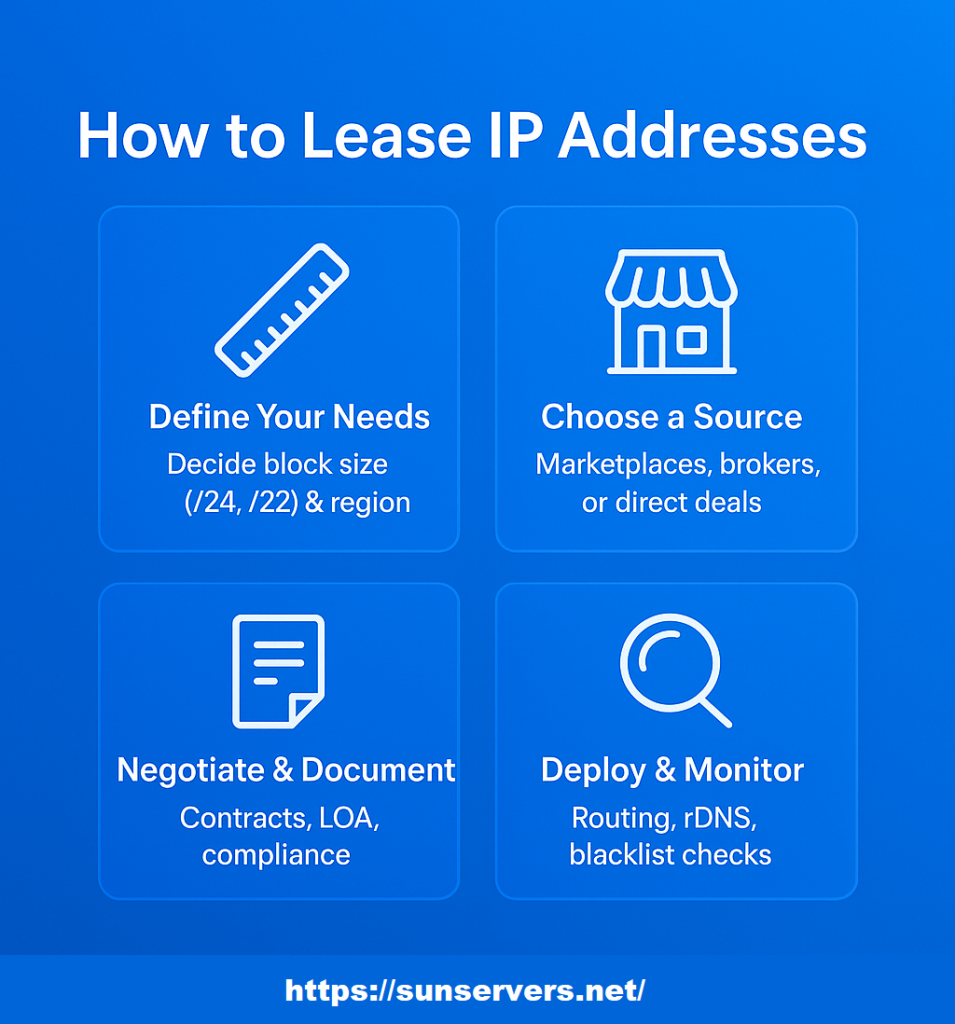
🔹 4. The Complete Step-by-Step Guide to Leasing IP Addresses
Let’s break down the full leasing process like a network architect’s checklist:
Step 1: Define Your Needs
Block Size: Use CIDR calculators to determine size:
`/24` = 256 IPs
`/23` = 512 IPs
`/22` = 1,024 IPs
Use Case Considerations: Hosting, SaaS, VPN, email campaigns, ad serving.
Geographic Requirements: Lease IPs in target regions to reduce latency and meet regulations (e.g., GDPR).
Step 2: Identify a Leasing Source
You can lease IPs via:
Marketplaces: Aggregators offering verified IP blocks from multiple RIRs.
Direct Lessor Agreements: Large enterprises leasing unused allocations.
Brokers: For high-volume custom deals.
Vet your partner:
RIR membership?
IP history transparency?
SLAs for routing and reputation?
Step 3: Compliance & Documentation
Letter of Authorization (LOA): Confirms your right to announce leased IPs.
SWIP/WHOIS Records: Updated ownership data in RIR databases.
Routing Authorization: ROA and IRR records to prevent BGP hijacks.
Step 4: Negotiate Terms
Pricing model: Monthly vs annual.
SLAs: Uptime, replacement for blacklisted IPs.
Lease length: Short-term (campaigns) or multi-year commitments.
Use Case: DNS health, reverse DNS lookups, email server blacklists.
Great for marketing teams to protect deliverability.
🔹 8. Pro Tips: Building a Bulletproof IP Leasing Strategy
Start Small, Scale Fast: Test with a `/24` before committing to a `/20`.
Diversify Across RIRs: Spread risk and avoid single-region bottlenecks.
Leverage Automation: Use APIs from AbuseIPDB or IPinfo for live monitoring.
Contract SLAs Carefully: Get guarantees for replacement of flagged IPs.
Hybrid Strategy: Own critical infrastructure IPs, lease for campaigns or traffic spikes.
🔹 9. The Future of IP Leasing: Beyond 2025
IPv6 growth: Projected 50%+ adoption by 2027, but IPv4 leasing demand stays strong for legacy integration.
IP-as-a-Service (IPaaS): Expect dedicated leasing platforms with automated onboarding and abuse remediation.
Regulatory Compliance: GDPR, data sovereignty, and cyber laws will make multi-RIR leasing even more valuable.
Market Forecast: IPv4 leasing is expected to grow 15% CAGR through 2030 as cloud, AI, and IoT demand accelerates.
🔹 10. Final Thoughts
Leasing IP addresses is no longer just a workaround for IPv4 scarcity—it’s a strategic advantage for IT leaders, CTOs, DevOps engineers, and marketers. It allows you to: ✅ Scale infrastructure without CapEx burdens ✅ Access clean, reputation-vetted IPs globally ✅ Stay compliant with ever-tightening regulations ✅ Operate with agility in a volatile market
With the right tools, strategy, and leasing partners, your organization can secure the IP space it needs to thrive—without the long-term lock-in of ownership.
Think of it as cloudifying your IP strategy: on-demand, scalable, and future-proof.