By- Mike Duckstein – Network Infrastructure Analyst
In today’s internet economy, IPv4 addresses are no longer just numbers—they’re prime digital real estate. Imagine if Manhattan had only a few plots left to sell but billions of businesses wanted a piece. That’s IPv4 in 2025. Despite IPv6 slowly rolling out, over 80% of global internet traffic still depends on IPv4, and demand isn’t slowing.
Whether you’re a cloud provider scaling infrastructure, a VPN company entering new markets, or a SaaS business running global campaigns, renting IPv4 addresses and subnets has become a strategic lever to grow without burning millions in capital.
This guide isn’t your average “pros and cons” blog post. Think of it as your CISO-approved, CFO-friendly, and network-engineer-endorsed playbook for understanding the advantages and disadvantages of IPv4 rentals, complete with market context, future predictions, and tools you’ll wish you knew sooner.
By unpacking the untold benefits—like cost efficiency, faster scalability, and built-in compliance support—alongside the risks of dependence and limited control, you’ll gain a clear lens into why IPv4 leasing has become the backbone of modern digital expansion. This isn’t just about IPs; it’s about shaping sustainable growth in a resource-scarce internet economy.
🧩 IPv4 Leasing vs Renting: Let’s Set the Record Straight
Before diving into the nitty-gritty, here’s a quick glossary of IP rental lingo—because nothing says “networking professional” like dropping acronyms casually in meetings.
IPv4 Address: A 32-bit numerical label assigned to devices on a network.
Subnet: A block of IP addresses defined using CIDR (Classless Inter-Domain Routing). For example, a /24 block = 256 IPs.
RIR (Regional Internet Registry): Governing body managing IP allocations (ARIN, RIPE NCC, APNIC, etc.).
LOA (Letter of Authorization): A document proving legitimate IP use.
ASN (Autonomous System Number): An identifier for a network on the internet.
Renting vs Buying: Renting means you temporarily lease addresses; buying means you permanently acquire and manage them as assets.
If you’re new to this space, renting IPv4 is essentially cloudifying IP resources—a flexible subscription model replacing heavy upfront investments.
🌍 IPv4 Scarcity in 2025: Why Renting Is Booming
Here’s the reality check: IPv4 exhaustion isn’t new, but its financial implications are accelerating.
In 2011, IANA allocated its last free IPv4 block.
By 2019, RIPE NCC was officially out of IPv4 addresses.
In 2025, IPv4 addresses trade for \$45–\$55 per IP, depending on region and block size.
Meanwhile, IPv6 adoption globally sits at \~45%, meaning IPv4 is far from irrelevant.
Why? Many legacy applications, IoT devices, VPN services, and even ISPs remain IPv4-centric. Renting is now a \$3B+ annual market projected to exceed \$5B by 2028, making IP addresses as investable as gold.
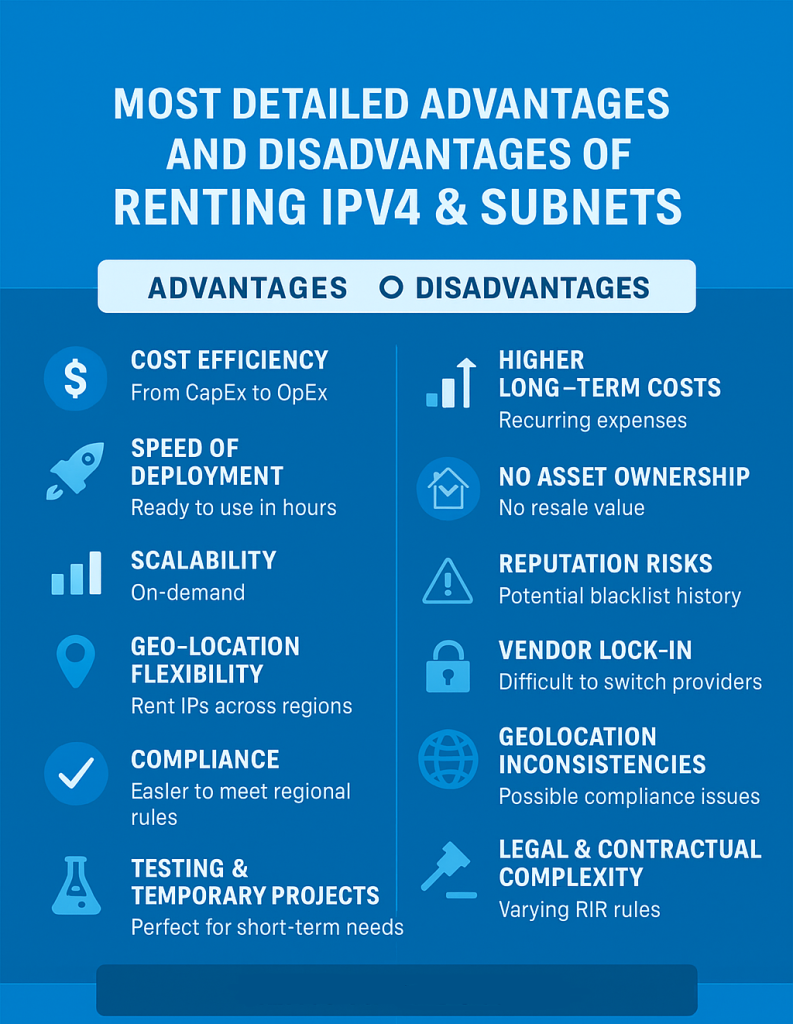
🟢 Advantages of Renting IPv4 & Subnets
Now let’s unpack the benefits of IPv4 rentals, not just from a financial perspective but also technical, operational, and strategic angles.
1. 💸 Cost Efficiency: From CapEx to OpEx
Buying IPs requires tens of thousands of dollars upfront. Renting shifts this to OpEx (Operational Expenditure)—you pay monthly or annually.
Example:
Buying a `/22` (1,024 IPs) = \~\$46,000.
Renting the same block = \~\$500–\$700/month.
For startups or businesses testing new markets, this subscription model minimizes financial risk. It’s cloud economics applied to IPs.
2. ⚡ Speed of Deployment
Waiting weeks for RIR paperwork is a growth killer. Renting means:
Pre-allocated IP blocks, ready to deploy in hours.
No delays in LOA approvals or transfer bureaucracy.
Renting offers elastic scaling. Need a `/24` today and a `/20` next quarter? Done. Renting aligns with modern DevOps workflows and the pay-as-you-grow cloud model.
For industries with seasonal surges—think holiday eCommerce, streaming, or online gaming—renting is a safety net.
4. 🌍 Geo-Location Flexibility
Owning IPs in multiple countries is complicated. Renting lets you “geo-hop” across continents instantly:
Improve CDN delivery by renting local subnets.
Bypass regulatory hurdles by using region-allocated IPs.
Tailor ads and services based on localized IP ranges.
5. 🔐 Compliance & Regulatory Adaptability
Certain jurisdictions require IPs allocated within their borders. Renting simplifies this:
GDPR or data localization compliance.
Legal edge for financial or healthcare industries.
6. 🧪 Perfect for Testing and Temporary Projects
Renting shines when you need IPs temporarily:
Penetration testing and cybersecurity simulations.
Staging or sandbox environments.
Blockchain nodes for pilot projects.
7. 💹 Hedge Against IPv4 Price Volatility
IPv4 is appreciating—much like property. Renting allows companies to avoid speculative risks while benefiting from usage flexibility.
🔴 Disadvantages of Renting IPv4 & Subnets
Now for the part vendors rarely talk about: renting isn’t a silver bullet. Here’s a brutally honest look at potential pitfalls.
1. 💰 Higher Long-Term Costs
If you need IPs for 5+ years, buying often makes sense. Renting is like leasing office space forever—you’re paying for flexibility at a premium.
2. 🚫 No Asset Ownership
Owned IPv4 addresses are financial assets. They can be resold, leveraged, or valued on your balance sheet. Renting offers zero asset appreciation.
3. ⚠️ IP Reputation Risks
Some rented subnets come with baggage:
Blacklisted IPs affecting email deliverability.
Poor reputation impacting SEO and ads.
You’ll need continuous monitoring (more on this later).
4. 🔗 Vendor Lock-In
Switching rental providers can break services if your applications rely on fixed IPs. Think VPN services losing subscribers due to IP churn.
5. 🌐 Geolocation Inconsistencies
IP registration might not match where it’s actually used. For location-sensitive services (fintech, ad targeting), this can create compliance headaches.
6. 🧾 Legal & Contractual Complexity
Renting involves strict agreements:
Regional registry rules (ARIN, RIPE NCC, APNIC).
KYC checks and LOA validation.
Cross-border taxation.
7. 🛠️ Operational Overhead
Renting isn’t “set and forget.” You need:
Tools for reputation management.
Scripts for routing validation.
Processes for renewal negotiations.
⚖️ Renting vs Buying IPv4: Quick Comparison Table
Factor
Renting IPv4/Subnets
Buying IPv4/Subnets
Initial Cost
Low, subscription-based
High, one-time CapEx
Speed to Deploy
Hours
Weeks or months
Scalability
Very high
Limited
Ownership
None
Full asset ownership
Long-Term Cost
Higher
Lower over time
Best Fit For
Short-term, growth scaling
Long-term, stable infrastructure
🛡️ Security, Routing & Compliance Checklist
If you rent IPs, trust but verify. Here’s a checklist:
VPN Provider: Rented `/19` blocks across 20+ countries to expand rapidly.
SaaS Startup: Rented `/24` for a year to warm up emails and scale user outreach.
IoT Pilot Project: Short-term subnet rental for regional device connectivity.
🔮 Future of IPv4 Renting
IPv6 adoption will grow, but IPv4 scarcity keeps it valuable. Expect:
Rising IP rental costs due to demand.
Tokenized IP assets traded like NFTs.
Automated IP marketplaces with AI-based reputation scoring.
For now, IPv4 renting remains a mission-critical strategy for agile enterprises.
🎯 Final Thoughts
Renting IPv4 is like leasing high-end office space: great for growth, flexibility, and rapid deployment, but you’ll pay a premium for convenience. If your infrastructure is stable and long-term, buying might be smarter.
Regardless of your choice, invest in:
SLA negotiations
Monitoring workflows
Security validation tools
Because in 2025, an IP address isn’t just an address—it’s a business-critical asset.